Website for a GP Practice or Clinic in the UK: The Complete 2026 Guide
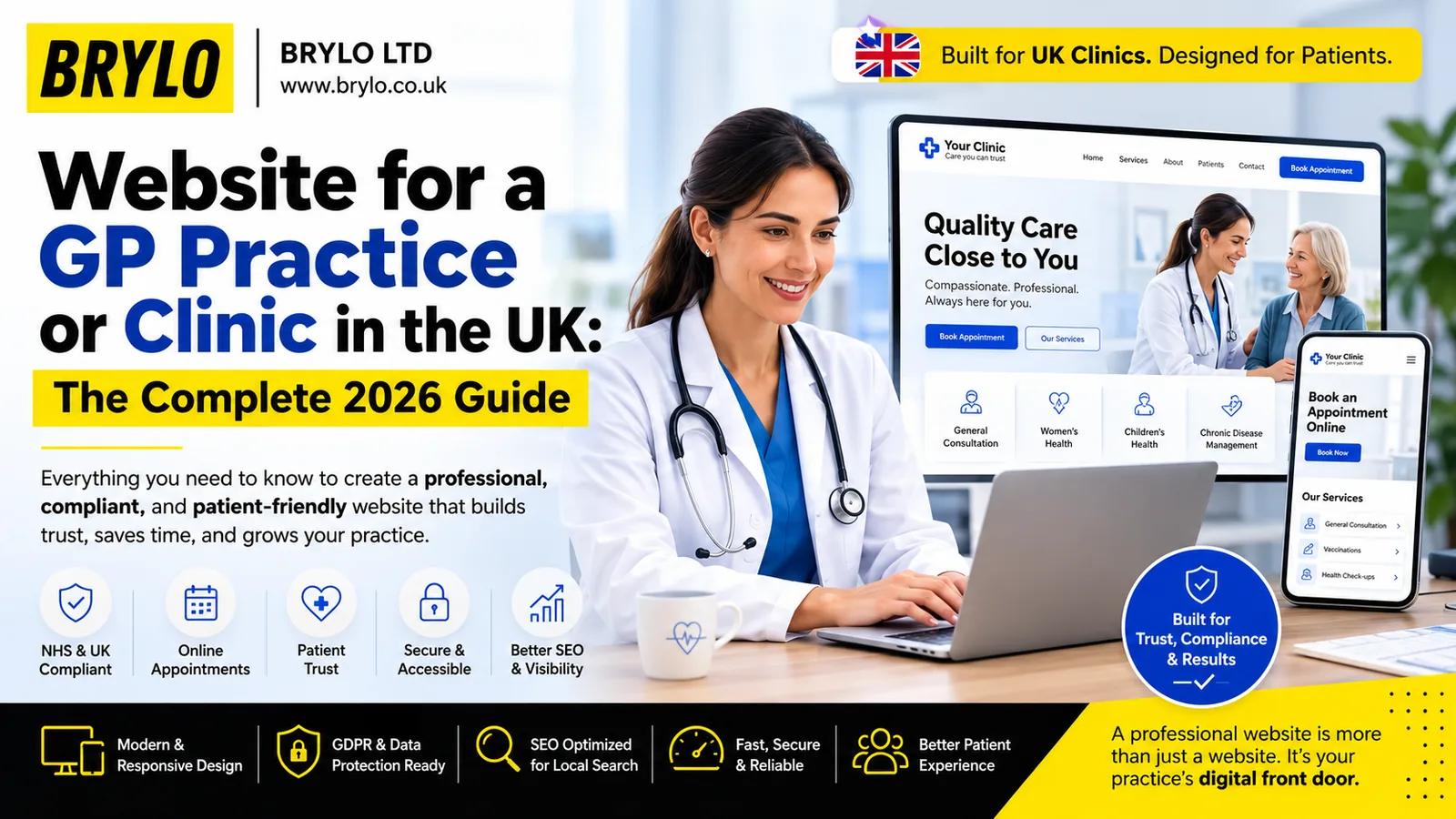
A website for a GP practice or clinic in the UK needs to do three things well: meet the law (WCAG 2.2 AA accessibility and UK GDPR), let patients act online through booking, consultations and forms, and load fast on a phone. In 2026 more patients contact their GP online than by phone, so the website is now the front door to the practice, not a brochure. A good one costs less than most people expect. A fixed, everything-included package runs around £999 a year. This guide covers exactly what you need, what it costs, and how to choose a provider, with a focus on GP practices and private clinics across the UK.
Why does your GP practice or clinic website matter more in 2026?
Because patients have moved online, and the numbers are not close any more. For the first time, the Office for National Statistics Health Insight Survey found that more people contacted their GP practice online than by phone. NHS England reported that more than 8 million online requests came into GP practices in October 2025, up 21% on the previous month and up 68% on the year before. Nearly all practices, 98.7%, now offer some form of online access.
When a patient wants to book, ask a question, order a repeat prescription or check your opening hours, they go to your website first. If it is slow, confusing or hard to use on a phone, they feel it before they ever reach your reception. That is why we built a dedicated clinic and GP practice website package: the site is the busiest member of the practice team now, and it should be treated that way.
What does a good GP practice or clinic website actually need?
Four things, in order of how often they get overlooked: it must be legal, usable, findable and safe. Get those right and the design looks after itself. Here is the short version before we go through each one.
| Requirement | What it means in practice |
|---|---|
| Accessible | Meets WCAG 2.2 AA so every patient can use it |
| Data-safe | UK GDPR-correct forms, cookie consent, secure hosting |
| Usable online | Booking, consultations and forms that work on a phone |
| Findable | Loads fast and ranks when patients search locally |
| Clear | Opening hours, services, staff and contact, easy to find |
None of this needs a huge budget. It needs a provider who builds healthcare sites properly from the start.
Accessibility: the legal must-have most sites get wrong
Accessibility is not optional for a healthcare website, and it is the single most common failing we see. There are more than 16 million disabled people in the UK, roughly one in five of the population, and a patient with a visual impairment, motor difficulty or cognitive condition still needs to book an appointment.
The law is specific. The Public Sector Bodies (Websites and Mobile Applications) Accessibility Regulations 2018 require public-facing NHS services to meet the Web Content Accessibility Guidelines (WCAG) at level AA, now WCAG 2.2. Even for a private clinic not strictly covered by those regulations, the Equality Act 2010 expects you to make reasonable adjustments, and an inaccessible booking form is a barrier to care.
In plain terms, WCAG 2.2 AA means proper colour contrast, text that resizes, everything usable by keyboard, labelled forms, and content a screen reader can read aloud. Every site in our clinic and healthcare websites solution is built to WCAG 2.2 AA as standard, because a healthcare site that some patients cannot use is not finished.
Data protection: UK GDPR and patient trust
A practice website handles personal data the moment a patient fills in a form, so UK GDPR applies. That means a clear privacy policy, secure forms that encrypt what patients send, a lawful basis for any data you collect, and a proper cookie consent banner that does not set analytics or marketing cookies until the patient agrees.
Two practical points matter most here. First, the site should collect as little as it can. A contact form does not need a patient’s full medical history. Second, your provider should register your practice’s data-handling correctly and keep the site patched, because an out-of-date website is how patient data leaks. We covered the security side of this in our Flamingo Medical & Wellness case study, a CQC-registered clinic in Basildon we rebuilt to be fast and secure with a much smaller data footprint.
Do GP practice websites have to meet NHS standards?
For NHS GP practices, yes, there are extra standards beyond accessibility, and it is worth being honest about them. NHS digital services are expected to align with the NHS Service Standard, and digital tools used in the NHS are assessed against the Digital Technology Assessment Criteria (DTAC), which covers clinical safety, data protection, security, interoperability and accessibility. Part of DTAC is a valid Data Security and Protection Toolkit (DSPT) submission.
Here is the honest version. A private clinic does not carry the full NHS-standards burden, and building an accessible, UK GDPR-correct site covers most of what matters. A public NHS GP practice, especially one integrating online consultation or patient-record features, needs a provider who understands DTAC and DSPT and will tell you exactly what applies before you sign. We build accessible, GDPR-aware healthcare sites, and we talk practices through the NHS-specific pieces rather than pretending they do not exist.
What features should a clinic website have?
The features that matter are the ones a patient actually uses. Everything else is decoration. Based on how patients behave in 2026, here is what earns its place.
- Online booking or consultation. With 6.5 million online consultation requests in a single month, this is now the main event. Patients want to act without phoning.
- Mobile-first design. Most patients arrive on a phone. The site has to be built for the small screen first, not squeezed down from a desktop layout.
- Fast loading. A slow page loses a patient before they book. Speed also helps you rank.
- Clear practice information. Opening hours, address, services, staff, how to register, how to get a repeat prescription. Easy to find, easy to read.
- Secure forms. Enquiry and registration forms that handle data correctly.
- Local SEO. Structured so you appear when someone searches for a GP or clinic in your town.
- Repeat prescription and admin links. Around one in three online requests are non-clinical, so make the admin easy.
Our app development and web design work is where we build these properly, and the clinic websites package bundles the healthcare-specific ones into a single yearly price.
Common mistakes GP practice and clinic websites make
Most struggling practice sites fail for the same handful of reasons, and all of them are fixable.
- Built for desktop, used on mobile. The site looks fine on the practice manager’s computer and falls apart on the patient’s phone, where most visits happen.
- A booking link buried three clicks deep. If a patient cannot find how to book or ask a question within a few seconds, they phone instead, which defeats the point.
- Ignoring accessibility. Low-contrast text, unlabelled forms and images without descriptions lock out a share of every practice’s patients.
- A cookie banner that fires before consent. Loading analytics or marketing cookies before the patient agrees breaches UK GDPR, and a surprising number of healthcare sites do exactly this.
- Slow, heavy pages. A page stuffed with oversized images and plugins keeps patients waiting and drags down search ranking.
- Losing control of the domain. The web address is registered to the old provider, so when the practice wants to move, it cannot take its own name with it.
We designed our clinic and healthcare websites to avoid every one of these by default, because in a healthcare setting each mistake is a patient who could not get what they came for.
How much does a GP practice or clinic website cost in the UK?
Less than most practices assume, and the range is wide. At the bottom, you can build it yourself on a site builder for a few hundred pounds a year, but you own the maintenance and the healthcare features are basic. At the top, a fully bespoke agency build runs into thousands before hosting. Most practices sit in the middle, on a managed provider that handles everything for a yearly fee.
| Option | Typical UK cost | What you get |
|---|---|---|
| DIY site builder (Wix, Squarespace) | £150–£350/year | You build and maintain it; limited healthcare features |
| Template GP-website provider | £335–£800+/year | Standardised template, shared design, basic support |
| Brylo clinic & healthcare websites | £999/year, all in | Custom design, UK hosting, domain, migration, care and support |
| Bespoke agency build | £2,000–£6,000+ build, plus hosting | Fully custom, higher cost, variable ongoing support |
The reason our £999-a-year clinic website package sits where it does is deliberate. You get a custom design rather than a shared template, but you pay one clear annual price with no separate build fee, and hosting, your domain, migration, security and support are all included. For a practice that wants a site that looks like theirs without an agency invoice, that is the sweet spot.
The My Surgery Website closure: what practices should do
If your practice is being moved off a closing provider, do not let the decision get made for you. My Surgery Website, a long-standing GP-website provider, is winding down, and practices that used it are being pushed to switch before deadlines. That is a real event, but the urgency in some of the marketing is a sales tactic. You have choices, and the most important thing is to keep control of your domain.
Here is what actually matters when you switch provider:
- Keep your domain in the practice’s name. Whoever you move to, your web address should be registered to you, so you never lose control of it.
- Get your content migrated properly. A good provider moves your pages, content and forms across for free, with no downtime.
- Do not overpay for urgency. Compare the real annual cost, not the panic.
- Choose UK-based support you can actually reach. A local team that answers beats a national ticket queue.
We handle exactly this kind of switch as part of the clinic and healthcare websites solution, including keeping your domain registered in your name. If you are weighing your options, we wrote more about matching the right technology to a real business problem in our guide to solving problems with software.
How do you choose a website provider for a clinic or GP practice?
Judge providers on the things that are expensive to fix later, not the sales pitch. Run any provider, us included, through this checklist before you commit.
- Do they build to WCAG 2.2 AA accessibility as standard?
- Is the site UK GDPR-correct, with proper forms and a real cookie consent manager?
- Will your domain stay registered in your practice’s name?
- Is there no separate build fee, so the annual price is the real price?
- Do they migrate your existing site for free if you are switching?
- Is support UK-based and quick to respond?
- Can they show you a real healthcare site they have built?
On that last point, we can. Our Basildon clinic case study is a live example of a fast, secure, accessible healthcare site we designed and built.
How do you help a clinic website rank locally?
Ranking for a search like “GP practice near me” or “private clinic in Essex” comes down to relevance, proximity and trust, and a well-built website supports all three. The site cannot do it alone, but it is the foundation everything else sits on.
A few things move the needle most:
- Say where you are, clearly. Your town and area should appear naturally in your page titles, headings and content, not buried in a footer. A clinic in Basildon should read like a clinic in Basildon.
- Use local structured data. Marking your practice up as a local healthcare business, with your address and the areas you serve, helps search engines and AI answer engines place you.
- Keep your details consistent. Your name, address and phone number should match exactly across your website, your Google Business Profile and any directories.
- Be fast and mobile-first. Local searches happen overwhelmingly on phones, and speed is a ranking factor as well as a patient-experience one.
- Earn genuine reviews. Patient reviews feed both your local ranking and the trust a nervous patient needs before booking.
This is the same digital marketing and technical-SEO thinking we build into every site, which is why our clinic websites are structured to be found, not just to look good. Increasingly it also means being readable by AI search engines like ChatGPT and Google’s AI Overviews, which now answer a growing share of “find me a GP near me” questions.
Do you build clinic websites in Basildon, Essex and London?
Yes. Brylo is a UK studio with a base in Essex, and we build for clinics and GP practices in Basildon, across Essex, in London and throughout the United Kingdom. Being local matters more than it sounds for a practice: you get a team that answers, understands UK healthcare rules, and can meet you where you are, rather than a faceless national subscription.
Wherever you are in the UK, the offer is the same. A custom, accessible, GDPR-correct website with UK hosting, your domain in your name, migration, security and support, for £999 a year, everything included.
Frequently asked questions
How much does a GP practice website cost in the UK? It ranges from around £150 a year for a DIY site builder to £2,000 or more for a bespoke agency build, plus hosting. Most managed providers charge a yearly fee. Our clinic and GP practice website package is £999 a year, all in, which covers custom design, UK hosting, your domain, migration, security, a care plan and support with no separate build fee.
Does a clinic or GP practice website have to be accessible? Yes. NHS and public-facing healthcare services must meet WCAG 2.2 AA under the Public Sector Bodies Accessibility Regulations 2018, and private clinics are expected to make reasonable adjustments under the Equality Act 2010. With more than 16 million disabled people in the UK, an inaccessible booking form is a barrier to care as well as a legal risk. Every site we build meets WCAG 2.2 AA as standard.
Do GP practice websites have to meet NHS standards like DTAC and DSPT? NHS GP practices are expected to align with the NHS Service Standard, and digital tools are assessed against DTAC, which requires a valid DSPT submission. A private clinic does not carry the same burden. The practical rule is that an accessible, UK GDPR-correct site covers most requirements, and a good provider will tell you exactly which NHS-specific pieces apply to your practice before you commit.
Can I move my GP practice website to a new provider? Yes, and it should be straightforward. A good provider migrates your pages, content and forms across for free, with no downtime, and keeps your domain registered in your practice’s name so you keep control. If your current provider is closing, compare the real annual cost of alternatives rather than acting on urgency, and prioritise keeping your domain.
What features should a clinic website have? The ones patients actually use: online booking or consultation, a mobile-first fast-loading design, clear practice information such as opening hours and services, secure enquiry and registration forms, repeat-prescription and admin links, and local SEO so patients find you. With more than 8 million online requests to GP practices in a single month, the online-action features matter most.
Is patient data safe on a practice website? It should be, if the site is built correctly. That means UK GDPR-correct forms that encrypt what patients send, a proper cookie consent banner, secure UK hosting, a clear privacy policy, and collecting as little data as possible. An out-of-date website is a common way data leaks, so ongoing security and updates matter as much as the initial build.
How long does it take to build a clinic or GP practice website? For a typical practice site, usually three to six weeks from kick-off to launch, depending on how quickly content and feedback come back. A migration from an existing provider can be faster because much of the content already exists. The build itself is rarely the bottleneck; gathering content usually is.
Do you build websites for clinics in London and across the UK? Yes. We are based in Essex and build for GP practices and private clinics in Basildon, across Essex, in London and throughout the UK, with UK-based support wherever you are.
About the author
Dharmendra Asimi is the Chief Technology Officer of Brylo, a UK web, app and AI studio, where he leads technology and design. He has spent close to two decades building websites, web applications and digital products, from WordPress and ecommerce estates to modern static and Next.js builds, for businesses across the UK, US and India.
At Brylo he works directly on client projects, choosing the architecture, writing the code, and making sure each build is fast, secure, accessible and sensibly priced to run. His focus is the engineering that quietly decides whether a site earns its keep: accessibility, performance, a small and defensible attack surface, UK GDPR-aware data handling, and software people actually use.
Areas of expertise: custom software and web application development · accessible, WCAG-aware front-end engineering · UK GDPR and privacy-first design · healthcare and clinic websites · technical SEO · Generative Engine Optimization (GEO) · cloud and serverless infrastructure · web security and hardening.
Connect: LinkedIn · X · Instagram · Brylo · Get in touch
If a figure in this article looks out of date next time you read it, tell us and we will verify and update it.
Run a GP practice or clinic and want a website that patients find easy and you never have to worry about? See our fixed-price clinic and healthcare websites, everything included for £999 a year, or tell us about your practice and we will come back with a clear plan.