Problem-Solving With Technology: How Custom Software, Automation and AI Grow a Business
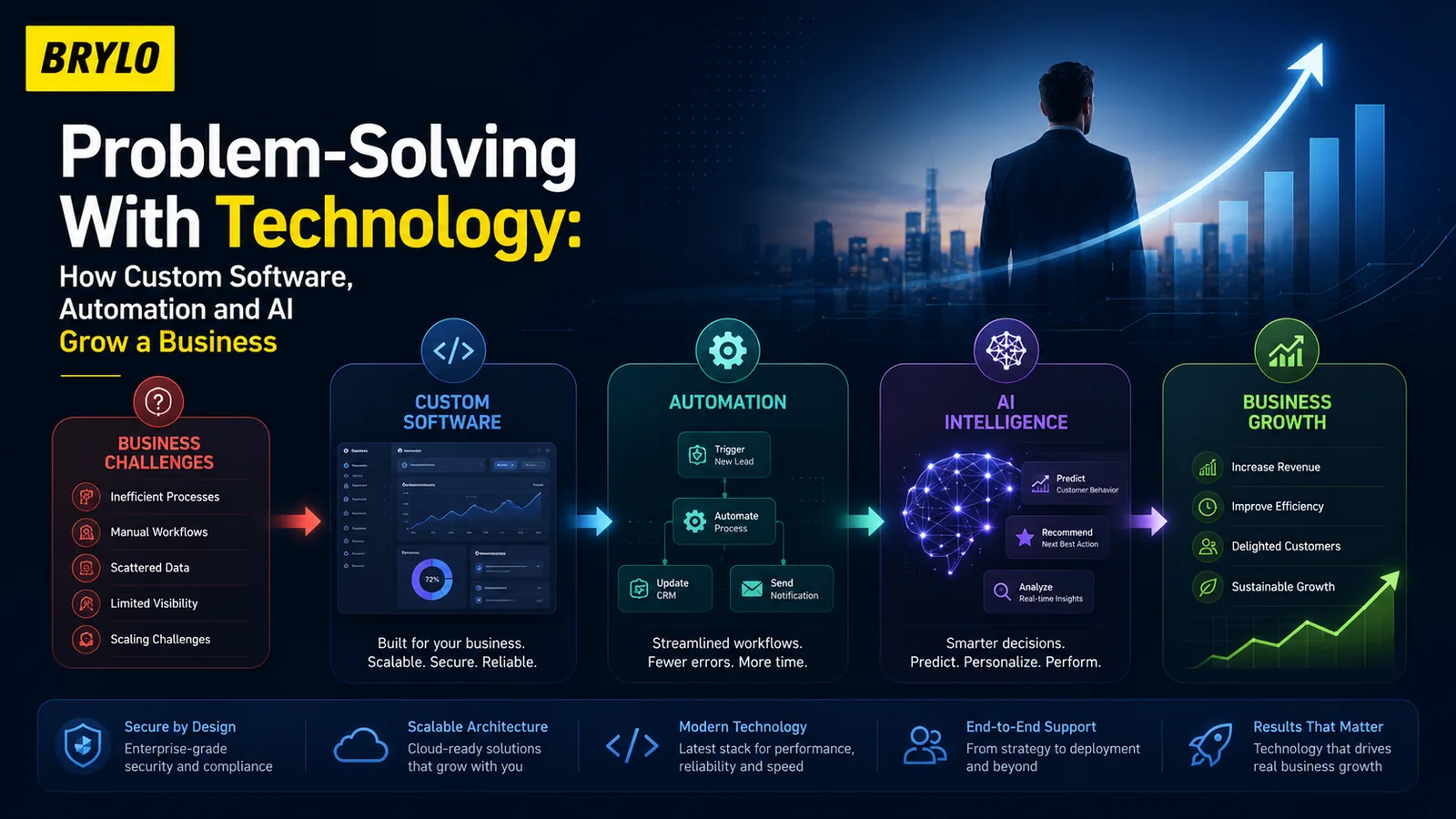
Almost any operational, marketing or productivity problem a business has can be solved by building the right software. That is the whole idea behind problem-solving with technology: you take a slow, manual process that eats hours and turn it into something a computer does instantly, correctly, every single time. Custom software, automation and AI have moved firmly within reach of small businesses, because modern frameworks and cloud tools have cut the cost of building them to a fraction of what it was a few years ago. This guide covers what the data says about the time and money involved, what to build for which problem, and how a company like ours keeps it affordable.
What does “problem-solving with technology” actually mean?
Strip away the jargon and it comes down to one move: find a job that people do slowly, repeatedly or inconsistently, and hand it to software. The software does not get tired, does not forget a step, and does not cost more when you do the job a thousand times instead of ten.
Most business problems fall into three buckets, and each has a software-shaped answer.
- Operational problems. Orders slipping through cracks, stock counts that are always wrong, jobs scheduled on a whiteboard. These are process problems, and software fixes them by making the process the same every time.
- Marketing problems. Leads that go cold because nobody followed up, no idea which advert actually made the phone ring, a mailing list nobody has touched in months. These are visibility and follow-through problems, and software fixes them by tracking and acting automatically.
- Productivity problems. Staff re-typing the same data into three systems, copying numbers between spreadsheets, spending Friday afternoon assembling a report by hand. These are the quiet killers, and they are the easiest of all to solve.

The point Brylo makes to every client is simple: if you can describe the problem clearly, it can almost certainly be built. The question is never really “is this possible?” It is “is this worth building, and can we build it affordably?” For most repetitive work, the answer to both is yes.
How much time do repetitive tasks actually cost?
More than most owners think, because the cost is spread out in fifteen-minute pieces across every week. It rarely shows up as a single line on a spreadsheet, so it hides in plain sight.
Start with the big picture. McKinsey Global Institute found in 2017 that around 30% of the activities in six out of ten occupations could be automated using technology that already existed at the time. Not whole jobs, but big slices of them. For one full-time employee, saving 30% of the working year is roughly 500 hours given back, per person, every year. Their 2023 analysis of generative AI pushed that ceiling higher again, estimating that current AI could handle 60 to 70% of the activities that fill knowledge-work roles.
Which tasks, specifically? The ones built on collecting and processing information, which is exactly what most back-office work is.
Read that chart the way we do when scoping a build. The tasks near the top, the data collection and data processing that fill finance, admin, operations and scheduling roles, are 60 to 80% automatable. The tasks near the bottom, judgement and genuine human relationships, are not, and should not be. Good software takes the first kind off your team’s plate so they have more time for the second.
What do you actually save by turning a task into software?
Three things, and they compound: time, errors, and the cost of both.
Take a real, ordinary example. A small firm takes booking enquiries by email, copies the details into a spreadsheet, checks a separate calendar for a free slot, replies to confirm, then adds a reminder to chase payment. Call it eight minutes per booking when nothing goes wrong. At forty bookings a week, that is more than five hours of admin, every week, on one process. Turn it into software and the customer picks a real, available slot themselves, the record writes itself, and the reminder sends on its own. The eight minutes becomes close to zero.

Here is the same logic across the kinds of task almost every business has.
| Repetitive task | Done by hand | As software | Typical saving |
|---|---|---|---|
| Booking and reminders | 8 min each, plus no-shows | Self-serve slot, auto-reminder | 5+ hours/week |
| Re-typing data between systems | 15 min per record | Written once, synced everywhere | Hours/week, fewer errors |
| Weekly reports | Half a day, manually assembled | Generated on a schedule | Half a day/week |
| Chasing invoices | Ad hoc, easily forgotten | Automatic reminders on a rule | Faster cash flow |
| Answering the same questions | Minutes each, all day | A chatbot or help centre | Frees the whole team |
The errors matter as much as the minutes. A person re-typing an order will get it wrong sometimes, and a wrong order costs far more than the fifteen minutes it took to enter. Software does the same job the same way every time, which is why the finance and operations teams that automate routine steps report both the hours back and a drop in costly mistakes. If your team spends its week feeding systems by hand, that is the first place we look. Our AI and automation work exists for exactly this.
Off-the-shelf, configured, or custom: which do you need?
Not every problem needs software built from scratch. Part of solving a problem well is choosing the right level of custom, and being honest when a cheaper option will do. There are three broad routes.
| Approach | Best for | Trade-off |
|---|---|---|
| Off-the-shelf tool | Common problems many businesses share | Cheap and fast, but you bend your process to fit it |
| Configured platform | Standard needs with your own rules and branding | Good middle ground; limited by what the platform allows |
| Custom software | A process that is genuinely yours, or a mix nothing covers | More to build, but it fits exactly and you own it |
A café does not need custom booking software; an off-the-shelf tool is perfect. A clinic with unusual scheduling rules might need a platform configured carefully, which is close to what we did in our Flamingo Medical & Wellness case study. A firm whose whole advantage is a process no competitor uses should build that process into custom software, because the fit is the point. We will always tell you when an off-the-shelf tool is the smarter buy. Selling someone a custom build they did not need is how studios lose trust, and we would rather keep it.
How does a CRM solve the sales problem?
By making sure no lead is ever forgotten and every follow-up actually happens. A CRM, short for customer relationship management, is simply a system that remembers every prospect, every conversation, and every next step, so your sales effort stops leaking out of the bottom of the funnel.
The effect on the numbers is well documented. Salesforce reports that businesses using a CRM see sales rise by up to 29%, sales-team productivity by up to 34%, and forecast accuracy by up to 42%.
The return on that has always been strong. Nucleus Research famously calculated that CRM paid back £8.71 for every £1 spent, and while later updates moderated that figure as software prices changed, the direction has never reversed. There is one honest caveat worth stating plainly: a CRM only works if people use it. Around half of CRM projects underperform, and the usual reason is poor adoption rather than bad software. That is why we build CRMs around how your team actually sells, not around a vendor’s idea of how they should. A simple system everyone uses beats a powerful one nobody opens.
How does an ERP solve the operations problem?
By putting the whole business on one set of numbers instead of five disconnected ones. An ERP, or enterprise resource planning system, connects the parts of a company that usually run in separate spreadsheets: stock, orders, purchasing, finance, and sometimes staff and production. When they share one live source of truth, the guesswork and the double entry disappear.
The reported outcomes are consistent across the research. Compiled ERP statistics from NetSuite show that roughly 74% of businesses report higher productivity after an ERP, about two-thirds say their operations became more efficient, and a similar share point to lower costs, particularly in purchasing and stock.
Panorama Consulting, which studies ERP projects every year, has put the average return on an ERP investment at around 168%. For a small business, you rarely need the full weight of a traditional ERP. You need the three or four pieces that hurt most, connected properly, which is where a lighter custom build often beats a heavyweight platform on both cost and fit.
What about problems that are uniquely yours?
That is where custom software earns its place. Off-the-shelf tools solve problems that many businesses share. When your problem is specific to how you work, or when your edge over competitors is a process nobody else runs, no product will fit, because none was built for you.
We have seen this shape again and again. A logistics firm that needs to route jobs by a rule only it uses. A membership body that manages renewals in a way no CRM anticipates. A manufacturer that wants its quote, its stock and its production schedule to talk to each other in real time. In each case the honest answer is to build it, because the fit is the whole advantage. Modern web and mobile app development makes this far more achievable than it sounds, and you own the result outright rather than renting it forever.
The rule of thumb we give clients: if a process is core to how you make money and no tool fits it well, that is a strong candidate for custom software. If it is a common, solved problem, buy the tool and spend your budget where it counts.
Where do automation and AI fit in?
They are the multiplier on everything above. Automation connects the software you already have so work flows between systems without a human carrying it across. AI adds a layer that can read, write, summarise and decide within limits you set, which pushes into tasks that used to need a person.

In practice, that looks like a chatbot answering the same twenty questions your inbox gets every day, a workflow that turns a paid invoice into an updated ledger and a thank-you email on its own, or an assistant that drafts the first version of a report from your live data. Gartner has tracked the move toward automating as many business processes as possible under the banner of hyperautomation, and the World Economic Forum’s Future of Jobs work describes the same shift in how tasks divide between people and machines. The practical takeaway for a small business is smaller and more useful than the headlines: pick the one repetitive task that annoys your team most, and automate that first. Momentum comes from a win people can feel, not from a grand plan. We wrote more about that pattern in our guide to choosing a UK web and software studio.
Isn’t custom software expensive?
It used to be. That is the honest history, and it is why so many owners still assume bespoke software is out of reach. The cost has fallen sharply, for reasons that are worth understanding because they are what make an affordable quote genuine rather than a discount that comes back to bite you.
Four shifts did it.
- Modern frameworks. Tools that did not exist a decade ago let a small team build in weeks what used to take months. Less code, written faster, with fewer bugs.
- Cloud and serverless hosting. You no longer buy and maintain servers. You pay for what you use, often pennies, and the infrastructure scales itself. Our Flamingo case study shows how far a database-free, cloud-served build can cut running costs.
- AI-assisted development. The people building your software now have AI helping them write and check code, which shortens the slowest, most expensive part of the work.
- Reusable building blocks. Payments, logins, messaging and maps are now services you connect rather than systems you build from scratch, and a modern backend platform such as Supabase, Firebase or Neon hands you a database, authentication and file storage out of the box. That alone removes weeks from a typical project.
At Brylo we pass that saving on rather than pocketing it, and we scope in phases so you start small and grow. A focused first version that solves one painful problem is usually a few thousand pounds, not the tens of thousands people fear, and it starts paying for itself the week it goes live. You can see how we price and work on our about page, and the wider service range on our web design and digital marketing pages. The goal is always the same: make the technology easy for you, and make it affordable enough that the maths is obvious.
How do you start solving a problem with technology?
Start with the bottleneck that costs you the most, not the shiniest idea. Here is the sequence we use with clients.
- Find the expensive repetition. Look for the task your team does most often, hates most, or gets wrong most. That is usually where software pays back fastest.
- Write down the current steps. If you can describe the process in plain English, it can be built. This step alone often reveals steps that can simply be deleted.
- Build the smallest version that helps. Solve the one painful problem first. A small win that works beats a big plan that stalls.
- Measure the hours and errors saved. Put a number on it. That number funds the next improvement and tells you whether to keep going.
- Expand from what works. Once one process is solved and measured, the next is easier, cheaper, and an easier decision.
You do not need a technology strategy to begin. You need one annoying, repetitive, expensive task and a team who can turn it into software. If you want ongoing help keeping it healthy afterwards, that is what our website and software care plans are for.
Frequently asked questions
Can any business problem really be solved with software? Almost any operational, marketing or productivity problem can, if it involves a repeatable process or information that needs collecting, moving or acting on. The realistic test is not whether it is possible, because it usually is, but whether it is worth building. For a task done often enough to cost real time or money, custom software or automation nearly always pays back. Pure human-judgement work and genuine relationship-building are the parts you keep for people.
How much time can automating a repetitive task save? More than most owners expect. McKinsey found that around 30% of the activities in most jobs are automatable, which is roughly 500 hours a year for one full-time employee. Even a single process, such as bookings or invoice chasing, commonly gives back several hours a week. The saving compounds because software does the task instantly and correctly every time, which also removes the cost of fixing mistakes.
Do I need a CRM, an ERP, or custom software? A CRM solves sales and follow-up problems by making sure no lead is forgotten. An ERP solves operations problems by putting stock, orders and finance on one set of numbers. Custom software solves problems that are specific to how you work, where no off-the-shelf tool fits. Many businesses use a combination, and part of our job is telling you which pieces you actually need rather than selling you all three.
Is custom software affordable for a small business? Far more than it was. Modern frameworks, cloud hosting, AI-assisted development and reusable building blocks have cut the cost of building bespoke software to a fraction of what it was a few years ago. A focused first version that solves one painful problem is usually a few thousand pounds, and we scope in phases so you start small and expand only once it has proven its worth.
What is the difference between automation and AI? Automation connects systems so work moves between them without a person carrying it across, following rules you define. AI adds a layer that can read, write, summarise and make limited decisions, which extends automation into tasks that used to need human judgement. Most useful projects combine the two: automation handles the flow, and AI handles the parts that need a little interpretation.
How do I know a project will pay off before I build it? Estimate the hours and errors the current process costs, then compare that to the cost of building and running the software. If a task takes five hours a week and the build pays for itself within months, the decision makes itself. We scope a small first version precisely so you can measure the return early, on real usage, before committing to anything larger.
Will I be locked into a supplier? Not with custom software you own. Unlike renting a platform forever, a bespoke build belongs to you, including the code and the data. We build on widely used, open technologies specifically so you are never trapped, and so another competent team could pick it up if they ever had to.
About the author
Dharmendra Asimi is the Chief Technology Officer of Brylo, a UK web, app and AI studio, where he leads technology and design. He has spent close to two decades building websites, web applications and digital products, from WordPress and ecommerce estates to modern static and Next.js builds, for businesses across the UK, US and India.
At Brylo he works directly on client projects, shaping the architecture, writing the code, and turning slow manual processes into software that saves time and grows sales. His focus is the engineering that quietly decides whether a system earns its keep: clean data, sensible automation, a small and defensible attack surface, and software people actually use.
Areas of expertise: custom software and web application development · business process automation · AI and workflow integration · CRM and ERP implementation · technical SEO · Generative Engine Optimization (GEO) · cloud and serverless architecture · UK GDPR-aware design.
Connect: LinkedIn · X · Instagram · Brylo · Get in touch
If a figure in this article looks out of date next time you read it, tell us and we will verify and update it.
Have a process that eats your team’s week? That is usually the cheapest problem to solve and the easiest to measure. Tell us the task at Brylo, or explore what we build across app development, AI and automation and web design.